Reviewed and updated: November 15, 2026
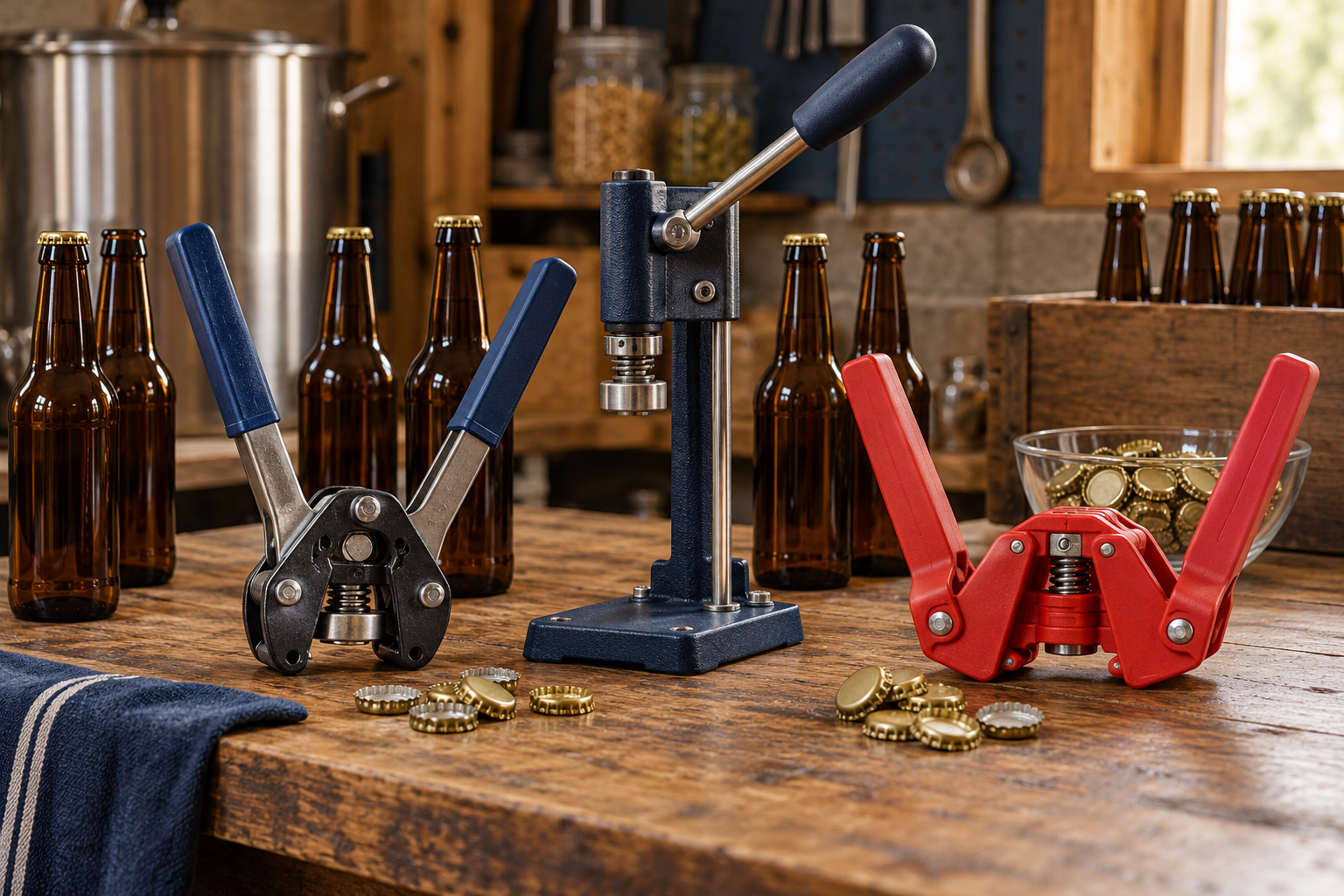
A crate of your own beer is a lovely thing to have ready for the next barbecue, tasting night or visit to a friend. Getting the caps on shouldn’t be the part you dread. For occasional bottling, we’d start with the Ferrari Emily two-lever capper: it’s a straightforward tool you can put away with the rest of your brewing kit. For regular batches, we’d give a bench capper the space instead.
The Ferrari Super Agata and KegLand bench capper both suit that more settled bottling spot. They bring the capping head down toward a bottle standing on a base, rather than asking you to work two handles around its neck. The better choice depends on your bottles, the room you have and how much of your beer ends up under a crown cap.
The Emily makes sense for a small bottling setup
There is a lot to like about a tool that doesn’t need its own corner of the garage. The Emily is a handheld, two-lever capper. Set it over a suitable crown-cap bottle and the two handles provide the closing action. Its magnetic bell helps hold the crown in position, while the grips give your hands a place to settle.
We’d lean this way when you bottle a small batch now and then, or when brewing equipment has to share a cupboard with ordinary kitchen things. You can bring it out beside the bottling wand, finish the job and pack it away. It also suits the brewer who already kegs most of the beer and only occasionally needs a separate bottling setup.
The compromise is how it feels over a run of bottles. Both hands are involved, and the bottle’s neck shape affects how a wing capper sits. A collection of suitable, similar bottles makes the job simpler than a random assortment. A bench model is worth considering when you’d prefer one lever and a base, especially if the two-handle movement feels awkward for you.
Ferrari Emily Two-Lever Bottle Capper
A handy choice for occasional bottling when you want the capper to pack away with your brewing kit.
Find in Amazon (paid link)
A bench capper earns its place when bottling is a regular event
The Super Agata is the sort of purchase we’d consider once bottling has become a familiar part of the hobby. Instead of lifting a handheld tool onto each bottle, you bring the bottle to the capping station. That change in layout is its main appeal. You can arrange filled bottles on one side and finished ones on the other, with a clear spot between them.
Its adjustable head lets you set the working height for your bottles. That is useful when your collection includes more than one size, though it doesn’t make every bottle or crown compatible. Grouping similar heights together keeps the session flowing without constant readjustment. It’s a small bit of organization that can make a full batch feel less fiddly.
We’d buy this format for a place where it can sit securely and where you can move the handle comfortably. The tradeoff is storage: a column and base need more room than a wing capper. A bench tool that spends every session wobbling on an unsuitable table is missing its point. Plan a stable working surface and follow the mounting directions for your version.
Think about the number of closures as well as the size of the batch. A few larger, suitable bottles for sharing make a different evening from a long line of smaller bottles. The more often you repeat that closing movement, the more worthwhile a comfortable, organized capping station becomes.
Ferrari Super Agata Bench Capper
We’d give this bench-style capper a spot when bottles are a regular part of your brewing routine.
Find in Amazon (paid link)
The KegLand is another practical bench option
KegLand’s bench capper has a steel frame, an adjustable head and a rubber grip pad on the bottle platform. Those are useful features for a dedicated bottling area: the base gives the bottle a defined home, and the head can move to suit different bottle heights. The bell has a magnet to hold the crown while you bring everything together.
We’d put it alongside the Super Agata rather than pretend the choice is settled by a longer feature list. Both offer the same broad benefit of a bench-mounted capping position. KegLand specifically provides for bolting its base to a sturdy surface, which makes it an appealing candidate when you have a suitable brewing bench ready for it.
The rubber pad is welcome, but it doesn’t remove the need for a steady base or careful alignment. Think about the space around the tool as well as beneath it. You want somewhere convenient for the next bottle and enough room for your hand on the lever. That matters more to an enjoyable evening of bottling than a claim about how quickly someone else can finish.
KegLand Bench Bottle Capper
A practical fit for a dedicated bottling bench, with a steel frame and a defined bottle platform.
Find in Amazon (paid link)
Let the bottles help choose the capper
The bottles already waiting in your brewing cupboard are part of this purchase. Use sound bottles intended for crown capping, with no chipped rims or cracks. Ordinary twist-off bottles aren’t a substitute for suitable pry-off bottles here. A capper is a closing tool, not a way to make damaged glass or an unsuitable bottle ready for beer.
The crown and the bell that crimps it also need to match. A 26 mm crown is a common homebrewing format, while some other bottles use 29 mm crowns. Emily packages differ: there are 26 mm versions and a version supplied with interchangeable bells for both sizes. Buy the configuration your bottles need; don’t assume every Emily box includes both. The same matching principle applies to a bench capper and its fitted bell.
For a new bottling collection, sticking with one suitable bottle format is an easy kindness to your future self. You can keep the adjustment familiar and store the right crowns together. Reusing suitable bottles is part of the pleasure of homebrewing, but you don’t need to keep every interesting shape that comes home from the bottle shop.
Keep the session easy, and the beer looked after
Before the filled bottles arrive, try the capper on a representative suitable bottle with water. A level crown with an even crimp is what you’re looking for; stop if a bottle sits crooked or the tool binds. Never use extra force or brace glass against your body to get past a jam. Sorting the fit first lets you give the beer your attention afterward.
Keep caps and beer-contact surfaces appropriately sanitized, and the mechanism clean and dry. Follow the tool’s own care directions rather than soaking the whole capper, and retire damaged arms, bells or cracked parts. Once you’re filling, work steadily and cap promptly. Our advice on keeping oxygen out during bottling is useful for looking after the beer you’ve already put time into making.
Which would we bring to bottling day?
The Emily is our pick for occasional bottling and limited storage. We’d move to a Super Agata or KegLand bench capper when bottles are a regular destination for the batch and there’s a secure place to work. Match the bell and bottles, choose the movement that feels manageable and leave room for the session to flow. When the beer is ready, pour it into a properly clean beer glass and enjoy sharing what you’ve made.