Reviewed and updated: November 14, 2026
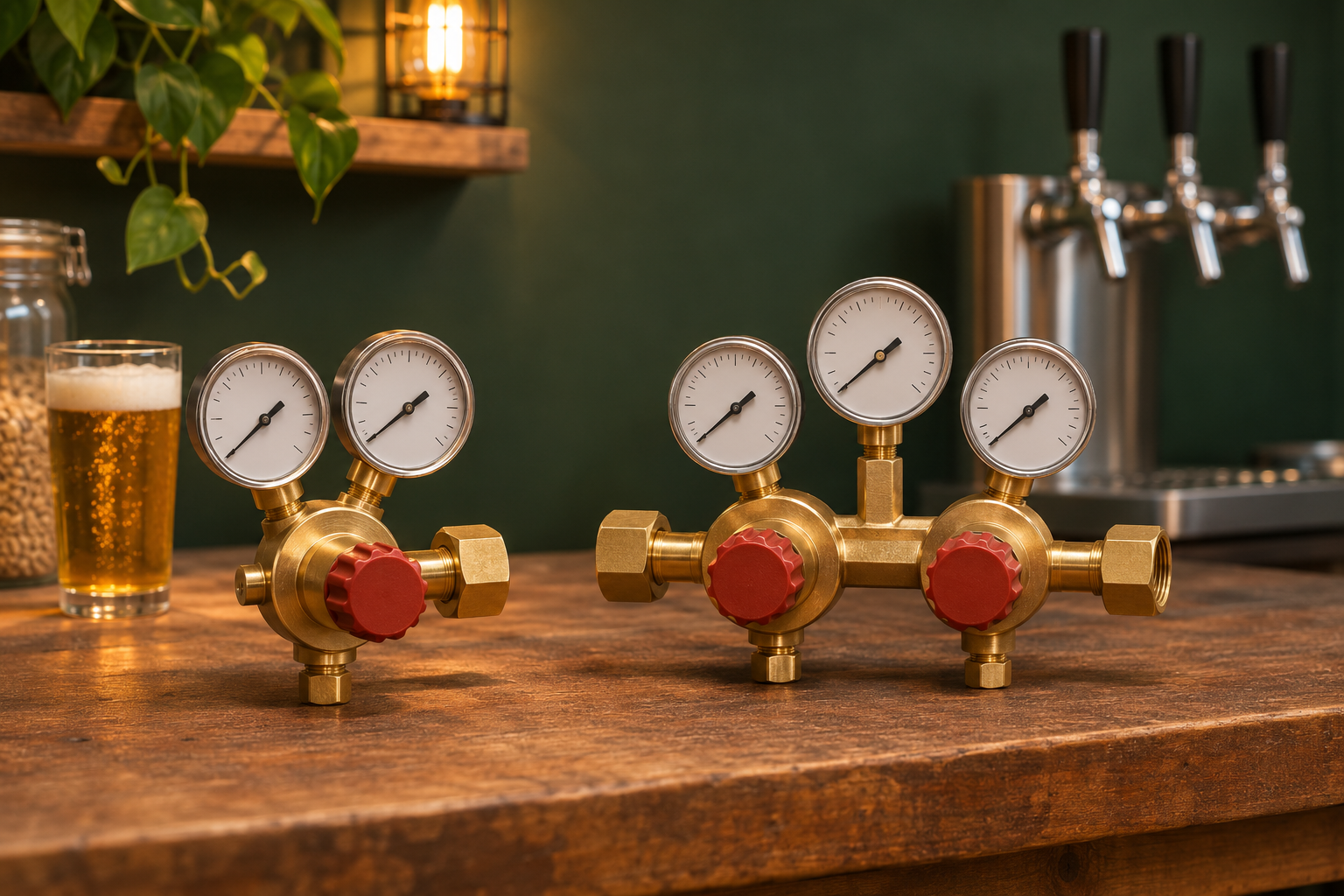
Two taps don’t automatically need two pressure settings. For a straightforward home keg setup, we’d start with the Taprite T742HP and keep things simple. The T752HP earns its extra space when you want two kegs running at different pressures from the same CO2 cylinder. That’s the useful difference here, rather than how many shiny gauges you can fit beside the fridge.
Think about the beer you like keeping on tap. Two similar beers can happily belong in a shared-pressure setup when their carbonation needs match. A lively wheat beer alongside a more gently carbonated ale gives you a better reason to want separate control. Buy for that difference, and you’re more likely to enjoy the upgrade after the excitement of new gear wears off.
One pressure or two: start with your beer
A primary regulator sits between your CO2 cylinder and the rest of your gas system. It reduces the cylinder’s pressure to a controlled supply for the keg equipment. Both of these Taprite models do that job; the T742HP supplies one adjustable pressure, while the T752HP has two independently adjustable regulator bodies.
That independence matters when the kegs need different treatment. You might want your usual serving pressure on one keg while carbonating another through its own properly rated setup. With two controls, changing one setting doesn’t require changing the other. You still need suitable keg hardware and a sensible carbonation plan, but you gain flexibility without adding a second cylinder.
By contrast, a manifold connected after a single-pressure regulator splits the gas supply without creating independently adjustable pressures. It can be a good arrangement for several kegs sharing one setting. Extra outlets and extra pressure controls solve different problems, so don’t buy a dual-body regulator simply because you’re adding another faucet.
Where the T742HP makes sense
The T742HP is the appealingly uncomplicated option for a first keg, a familiar house beer, or a system where every keg can use the same pressure. You have one adjustment to look after and a smaller assembly to accommodate than the two-body model. That leaves you thinking about what to brew next rather than finding room for controls you don’t need.
Its two gauges show the regulated outlet pressure and the cylinder-side pressure. Two gauges don’t mean two separately controlled kegs: this is still a single-pressure regulator. The standard model has one shutoff outlet with a check valve and a 5/16-inch hose barb, so the rest of your gas arrangement needs to suit that connection.
For two kegs that will share a setting, a suitable manifold is one route. Taprite also makes the T742-2, a single-pressure model with two outlets. That’s a useful middle ground to know about before paying for independent controls. Plan the complete gas path, including shutoffs and appropriate backflow protection, rather than assuming every extra fitting is included with the regulator.
Taprite T742HP Primary CO2 Regulator
A sensible starting point for a straightforward keg setup that needs one shared serving pressure.
Find in Amazon (paid link)
What the T752HP adds to your brewing corner
The T752HP puts two pressure controls on one cylinder connection. Each body supplies its own outlet, and the assembly has two outlet-pressure gauges plus the cylinder-pressure gauge. You get a clearer match for a two-keg setup with different carbonation needs, without having two separate cylinders to store and refill.
This is the option we’d lean toward for a home bar that regularly serves different beer styles. It also suits a brewing rhythm where a fresh keg is being prepared while another is already pouring. The benefit comes from genuinely needing those separate settings, not from a promise that more equipment will make the beer taste better.
There’s a physical tradeoff. Two bodies, adjustment knobs, gauges and outlet connections need more room around the cylinder. Before buying, allow space to read both low-pressure gauges and reach the controls without straining the fittings. A fridge door, shelf or keg handle can turn an otherwise sensible arrangement into a nuisance.
Taprite T752HP Dual-Body CO2 Regulator
Independent pressure controls make this a useful upgrade for two kegs with different carbonation needs.
Find in Amazon (paid link)
Match the connections before adding accessories
The standard T742HP and T752HP discussed here use a CGA320 cylinder connection and 5/16-inch hose-barb outlets. Taprite also sells variants with different outlet fittings or regional cylinder connections. Your cylinder supplier and existing gas hose determine what fits; a similar-looking regulator with a different suffix isn’t automatically interchangeable.
Bring that connection information to your gas supplier or homebrew shop when you’re unsure. Buying around the equipment you already own is much easier than trying to adapt an incompatible cylinder connection afterward. Keep the hose, clamps, keg disconnects and any additional fittings appropriate for the gas system and its intended pressure.
Both models have a brass body and a polycarbonate adjustment bonnet. Those are useful construction details, but they don’t settle the choice between them. The number of independent pressures, connection fit and available space will make a much bigger difference to your everyday brewing setup than a longer list of materials.
The pull-to-adjust, push-to-lock knob is a welcome detail when you want to leave a setting alone between pours. Give it enough clearance to operate comfortably. On the dual-body model, keeping each gas line clearly associated with its own keg also saves confusion when you swap a finished keg for your next batch.
Better control still needs a balanced pour
Separate regulators can’t give two beers separate temperatures inside one fridge. Temperature affects carbonation and pouring, so start with the temperature you can actually maintain and the carbonation you want for each beer. There isn’t one pressure setting that suits every style and serving arrangement.
A new regulator also won’t put a short, warm or poorly matched beer line right. Our guide to sorting out keg foam helps you work through that side of the setup. It’s worth finding the cause before buying more gas controls to solve a pouring problem they weren’t designed to fix.
Sharing one cylinder keeps the setup tidy, but it also gives both gas branches the same supply. When that cylinder needs a refill, both sides are affected. Independent pressure control is different from having a spare gas supply, which is worth remembering before a gathering where you’re counting on both taps.
Make room for safe, comfortable ownership
CO2 equipment deserves a proper place in the brewing corner. Keep the cylinder secured upright, away from heat, in a suitably ventilated area. Follow the regulator, cylinder and keg-equipment instructions for installation, leak checks and pressure relief. Never connect a cylinder directly to a keg without the required regulating and safety equipment.
You should be able to see the gauges without moving a pressurized cylinder around. A steady rise in pressure without adjustment, damaged gauges or unusual regulator behavior calls for stopping use and contacting the supplier. It isn’t a reason to keep compensating with the knob while hoping the next pour behaves.
Which one would we buy?
The T742HP is our starting point for one serving pressure and a simple keg setup. Move to the T752HP when two independent pressures will serve the beers you actually keep on tap, and you have room for the larger assembly. That’s a worthwhile upgrade for a varied home bar; otherwise, keep the extra space for another keg and enjoy the simpler arrangement.